Shock and Drop Testing Services

ATA Engineering can provide a solution for your shock or drop test. Shock testing is often performed as part of a hardware qualification or design process. Information obtained during shock testing can improve the survivability of products as well as verify that they will perform properly in service. These types of tests require special transducers and measurement systems to record and process high level, high frequency response. ATA has a large array of the equipment required to conduct these tests and provide timely results to enable a shock testing program to be conducted quickly.

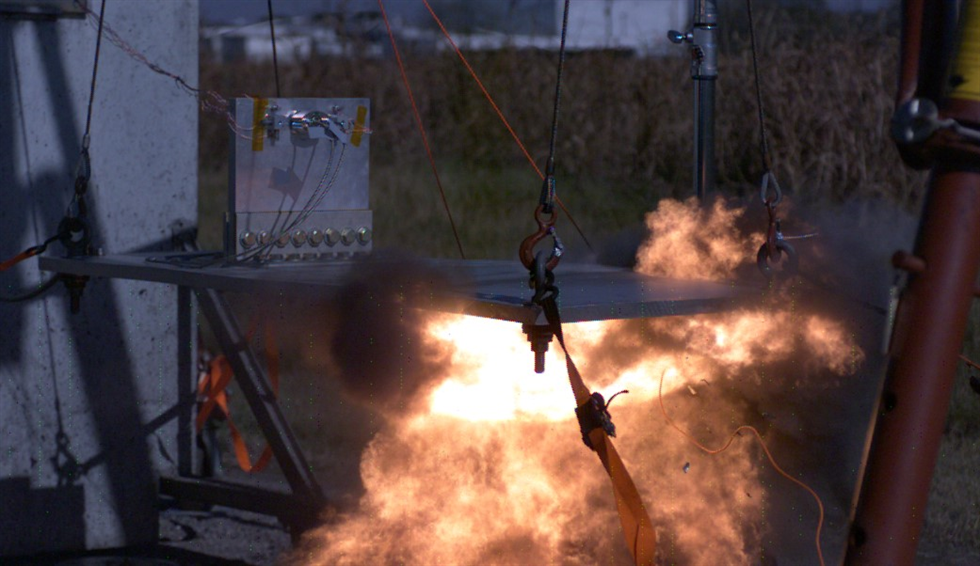
We have experience in a wide variety of pyroshock, blast, drop, and separation type tests. Special consideration is usually required for this type of testing because it is usually a one time event or is too expensive to repeat. Backup data acquisition systems are typically required in order minimize risk.

Pyroshock Testing

A pyroshock event is typically used to separate multiple stages of a rocket, missile, or launch vehicle. An explosive device is detonated to break free or separate components, deploy a payload, or perform some other function. This blast causes both a mechanical shock wave and acoustic (airborne) shock wave that propagates through and around the structure. Characterizing this event is critical in component and isolation design to ensure each component or subsystem can survive the event and perform its task.

ATA was the first company to utilize MEMs technology in a high level shock sensor (model 3501A1260KG), developed by PCB Piezotronics Inc., to measure acceleration within ½ inch of a pyroshock source. Levels above 60,000 G’s were successfully recorded. ATA can measure a shock event, evaluate data integrity, and post process within minutes after shock test completion. It is important to evaluate shock data quality and we have the knowledge and experience to do so. Integrating of acceleration into velocity, time history signal analysis, and evaluation of frequency domain spectrum provides valuable insight to data quality. The shock response spectra (SRS) are typically used as the end product of shock testing. ATA’s IMAT toolbox can quickly and accurately compute the SRS for each measurement.


Acceleration time domain response of a triaxial accelerometer during a pyroshock event.

Shock response spectra (SRS) computed for a triaxial accelerometer during a pyroshock event.


Drop Testing

A drop event is typically induces much lower peak G-levels and frequency content than a pyroshock event but still requires proper testing techniques and equipment to perform successfully. Drop testing can be used to evaluate product durability, packing material performance, isolator performance, or used to simulate other shock events.

ATA has performed drop and impact testing for both aerospace and commercial customers. These tests are used to validate transportation equipment and packaging of sensitive electronics components. Peak accelerations are measured as well as structural displacements to evaluate loads transmitted and determine if an impact event will occur under specified conditions. The test data is then used in developing design specifications and assessing structural performance characteristics.

Structures tested by ATA include satellite transportation systems, military munitions, hand held electronic devices and sporting equipment. Smaller test articles may be tested at ATA’s test laboratory in San Diego while larger test articles are tested at the customer’s facilities.